Back to all

The short of it
- AI assistants pick products from feed data, not marketing copy. Attribute completeness, current pricing and inventory, and credibility signals decide whether an agent recommends your product or a competitor’s.
- Commerce GEO gets a SKU selected; content GEO gets an article cited. Most published GEO advice covers only the second, so following it won’t make your products visible to shopping agents.
- You can measure your answer share starting today. Ask ChatGPT, Gemini, and Copilot the questions your shoppers ask, then track which products they recommend each month.
- Keep your SEO budget. The same structured-data work that earns search rankings is what makes products selectable by AI assistants.
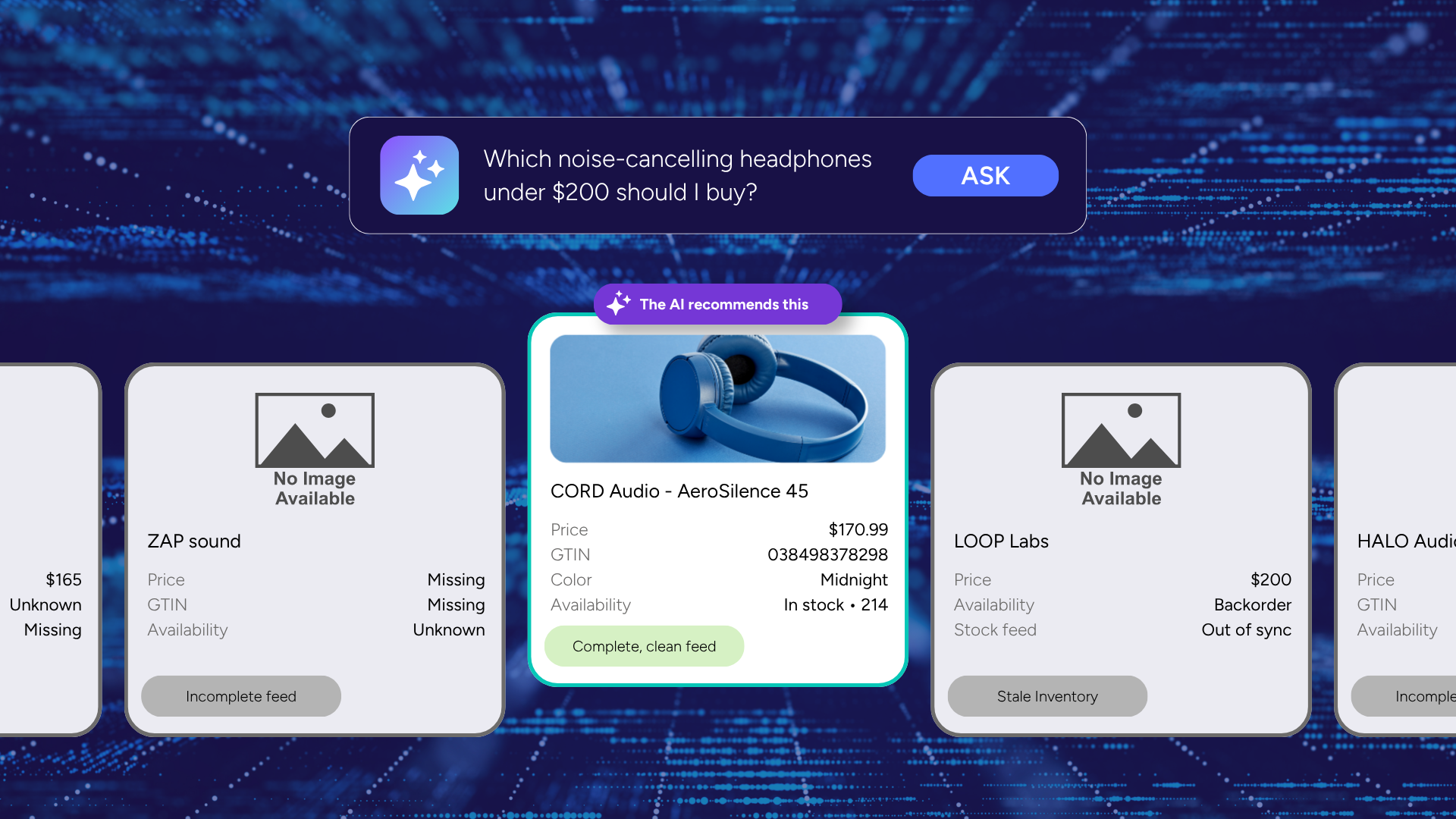
An AI shopping assistant returns one answer: a handful of products, no page two, no chance to rank eleventh and still get found. What decides whether your product makes that answer is feed data: attributes, pricing, and inventory, structured so the assistant can read them. Most generative engine optimization advice teaches you to get articles quoted, not products recommended.
What is commerce GEO?
Commerce generative engine optimization (GEO) is the practice of structuring product data so AI assistants and shopping agents can find, evaluate, and select your products. Where content GEO gets an article cited, commerce GEO gets a SKU selected. Selection runs through feeds, attributes, inventory freshness, and variant accuracy far more than page authority or backlinks.
For brands and retailers, the number to chase is answer share: how often your products appear when an assistant answers the questions your shoppers actually ask.
What do AI shopping agents actually evaluate?
An agent handling a product request works through a short, ruthless sequence: interpret the intent, pull candidates, filter, rank, recommend. Your products survive that sequence based on four things.
Attributes written the way shoppers ask
Agents match natural language to product data. “Fits under an airplane seat” only matches your carry-on if the dimensions and the use case live in your attributes, in language a model can connect to the request. Audit your top SKUs against the questions shoppers actually pose. If the answer to “does this work for X” exists only in a lifestyle photo or a PDF spec sheet, the agent can’t use it.
Freshness the agent can trust
Recommending out-of-stock or mispriced products erodes shopper trust, so assistants favor listings with current, machine-readable price, inventory, and variant data. A catalog that syndicates in real time beats a better product with a stale feed. This is the least glamorous work on the list and the most disqualifying when it’s skipped: when a feed is incomplete or outdated, the system skips the listing.
Facts an assistant can confirm
Materials, dimensions, availability by location, shipping cutoffs, returns policy. Encode them as structured facts, because agents favor claims they can confirm against your data. A claim the model can’t confirm functions like a claim you never made.
Credibility beyond your own catalog
Models weigh reviews, ratings, and third-party mentions when choosing between comparable products. You can’t fabricate this layer, but you can make it legible: structured review markup, consistent product naming across channels, and presence on the marketplaces and retail sites models index heavily.
How do you measure answer share?
There’s no Search Console for LLMs yet, so measurement is manual. Write down the ten prompts that should surface your products. Run them across ChatGPT, Gemini, and Copilot. Record what gets recommended, including which competitors appear and why the model says it chose them. Repeat monthly and after major catalog changes.
Low-tech, but it works. It’s the same method we walked through in the uncomfortable truths of the agentic commerce era: the teams doing this today know their answer share while their competitors are still debating whether to track it.
Should you move budget from SEO to GEO?
No. Organic search still pays. Dropping it to chase AI visibility trades a working channel for an emerging one. GEO extends the same data discipline SEO taught you, applied to a new set of readers: clean structured data, accurate availability, and language matched to real queries improve both channels at once. We covered the reallocation question in busting 5 myths about agentic AI in commerce. Extend, don’t swap.
Where the work starts
Everything above is feed and catalog work you can begin this quarter, and the brands measuring answer share now are building a baseline their competitors don’t have.
The proof already exists. A leading beauty brand is live with an AI search partner today, answering shopper queries with structured data pulled in real time from Rithum’s feed. When a hero product goes invisible to AI assistants, the cause is almost always upstream data, a gap one brand closed by fixing catalog readiness rather than marketing. Tools like Catalog Assist and AI Magic Mapper already handle the attribute gaps and cross-channel categorization that make this scale, as part of the agentic commerce funnel, and our roadmap extends toward GEO optimization and LLM visibility monitoring.
If your products aren’t being selected, the fix starts with your data. See how Rithum prepares catalogs for AI-driven discovery.
Download the infographic: Is your product in the AI answer?
FAQ
Commerce GEO is the practice of structuring product data (attributes, pricing, inventory, variants, reviews) so AI assistants and shopping agents can accurately find, evaluate, and recommend your products when shoppers ask in natural language.
No. SEO continues to drive measurable revenue, while GEO addresses the growing share of discovery happening inside AI assistants. The two share a foundation of structured, accurate product data, so investment in one strengthens the other.
Run your priority shopper prompts across the major assistants each month and record which products get recommended. Manual answer-share tracking is the most direct method available today.